Simple AI workflows are often more useful than ambitious automations. Most teams do not need a fully autonomous system. They need one repeatable flow that handles the boring middle of a task while leaving judgment and approval to a person.
That is also where the primary-source guidance points. Anthropic explicitly distinguishes workflows from agents and recommends starting with the simplest solution that can work. In practice, that means fixed steps, narrow tools, and clear review points. Those are the ingredients behind the best simple AI workflows.
- The most reliable simple AI workflows use fixed steps, clear inputs, and human approval before anything important leaves the system.
- Prompt chaining, routing, parallel review, evaluator loops, and approval checkpoints are the most practical starting patterns.
- The right goal is not full automation. It is consistent time savings on a narrow recurring task.
Table of Contents
- Workflow Overview
- Architecture and Components
- 5 Simple AI Workflows That Save Time
- Failure Modes
- Human-in-the-Loop Points
- How to Start Without Overbuilding
- FAQ
- Related Reading
- Source
Workflow Overview
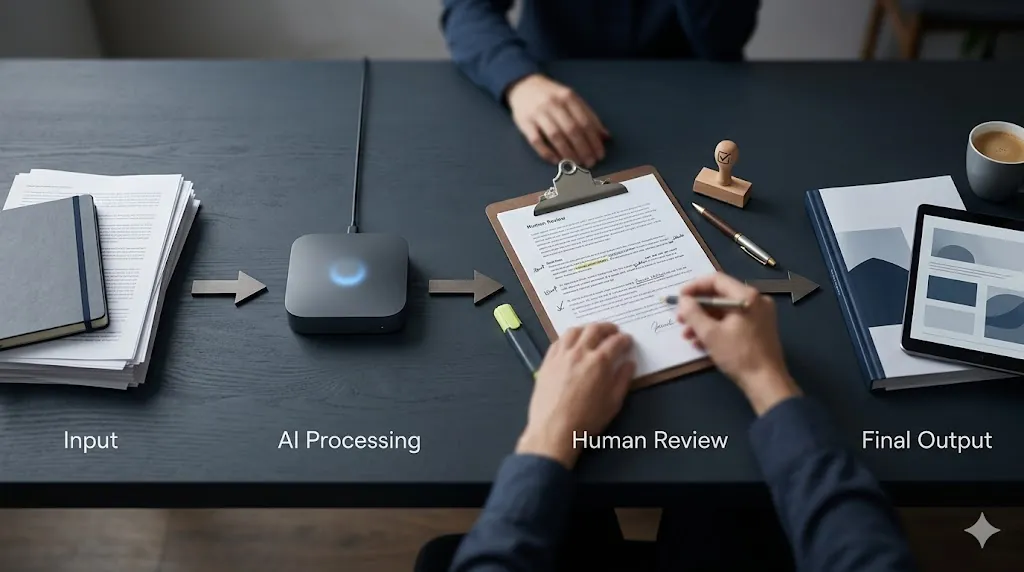
A useful workflow has three parts: input, processing, and output. The input is the material the system receives. The processing is the narrow AI step or set of steps. The output is what comes back for review, approval, or action.
That sounds obvious, but it is the reason simple AI workflows work. They stay legible. You can see what goes in, what the model does, and where the person steps in before anything risky happens.
Architecture and Components
1. A narrow job to be done
Anthropic’s workflow guidance is clear: complexity should be earned. If the task is not narrow enough to describe in one sentence, the workflow is probably too broad.
2. A fixed pattern
Prompt chaining, routing, parallel review, evaluator loops, and orchestrator-workers are useful because they give the work a stable structure instead of one giant vague prompt.
3. A review point
OpenAI’s Agent Builder and Zapier’s Human in the Loop documentation both emphasize approval steps before external actions. That is a strong signal that human review is not optional window dressing. It is part of the design.
5 Simple AI Workflows That Save Time
1. Outline -> check -> draft
This is the cleanest example of prompt chaining. First, the model produces an outline. Then a second step checks the outline against criteria. Only then does it draft. Anthropic uses this kind of fixed sequence as a core workflow pattern because it reduces drift.
Input: topic, audience, constraints. Process: outline, criteria check, draft. Output: review-ready first draft.
2. Triage and route incoming work
Routing is one of the best simple AI workflows for support, ops, or shared inbox work. The first step classifies the input. The second step sends it to the right specialist prompt, tool, or human queue.
Input: ticket, request, or message. Process: classify and route. Output: cleaner downstream handling.
3. Summarize first, approve second
This workflow is ideal for weekly updates, meeting notes, and report drafts. The model creates a draft summary, but a person approves it before it is sent or published. OpenAI’s human approval node and Zapier’s approval steps map directly to this pattern.
Input: transcript, thread, or document pack. Process: summarize and stage. Output: approved update.
4. Parallel review across multiple criteria
Anthropic’s parallelization pattern works when one item needs several types of review at once. For example, a content draft can be checked in parallel for clarity, brand fit, and policy risk, then merged into one review layer.
Input: draft or proposal. Process: multi-angle review in parallel. Output: consolidated issue list.
5. Draft -> critique -> improve
The evaluator-optimizer loop is one of the most practical workflows for better quality without much extra complexity. One step generates. Another critiques. A third improves. This is often enough to make the output noticeably stronger.
Input: prompt and initial draft. Process: generation, critique, revision. Output: cleaner final version.
Failure Modes
- The workflow tries to do too much in one pass.
- The input is vague, so every later step is vague too.
- No review step exists before an outbound action.
- The pattern is called “simple” but actually depends on too many tools and hidden branches.
Human-in-the-Loop Points
Human review matters most before messages are sent, records are changed, money moves, approvals are issued, or external systems are updated. That is where an AI shortcut becomes a business risk if the checkpoint is missing.
The best simple AI workflows do not remove humans. They move humans to the moments where judgment matters most.
How to Start Without Overbuilding
Start with one narrow workflow that already happens every week. A meeting summary flow, a content brief flow, a routing flow, or a report draft flow is enough. If it saves time for two weeks in a row, then improve it. If it does not, shrink it again.
A simple checklist helps:
- Define one input.
- Define one output.
- Limit the number of steps.
- Add one review point.
- Measure whether time is actually saved.
FAQ
What are simple AI workflows?
They are narrow, repeatable workflows where AI handles part of a task while a human still reviews or approves the important parts.
Are simple AI workflows the same as agents?
No. Anthropic draws a clear distinction between predefined workflows and more autonomous agents.
Where should human review happen?
Before any step that sends, changes, buys, approves, or publishes something important.
What is the easiest workflow to start with?
A summary or draft-improvement workflow is often the easiest because the output is easy to check quickly.
Related Reading
- AI Agent Workflow: 5 Steps Regular Users Can Actually Run
- Microsoft Declarative Agents: 5 Practical Pilot Rules
- Deep Research vs Search vs ChatGPT
- More AI workflow coverage