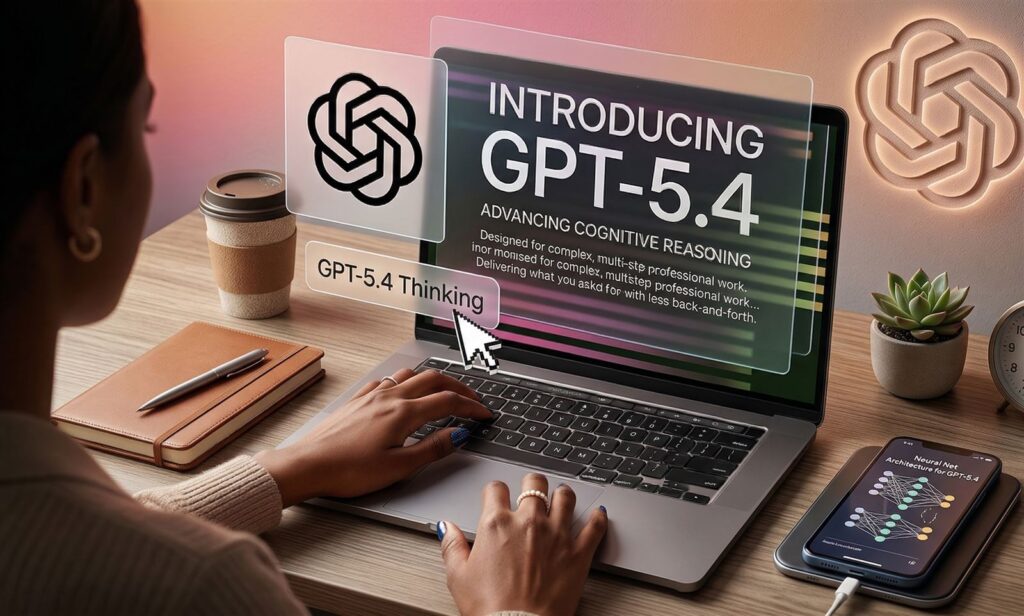
GPT-5.4 arrived in ChatGPT, the API, and Codex on March 5, 2026. The launch headline mattered for a week. The more useful question now is more practical: where does GPT-5.4 actually feel better when you use ChatGPT for everyday work?
That is the angle this draft follows. Instead of treating GPT-5.4 like a benchmark story, it treats it like a work-quality story. If you use ChatGPT for notes, drafts, spreadsheets, planning, or long prompts that usually need cleanup, the important issue is whether the upgrade saves time, reduces rewrite loops, or keeps context together better than before.
- OpenAI launched GPT-5.4 in ChatGPT, the API, and Codex on March 5, 2026.
- For ChatGPT users, the biggest shift is better work across documents, spreadsheets, presentations, and tool-heavy tasks with less back and forth.
- GPT-5.4 Thinking replaced GPT-5.2 Thinking for paid users, while GPT-5.2 Thinking stays in Legacy Models until June 5, 2026.
Table of Contents
- What Changed on March 5, 2026
- What Regular ChatGPT Users Actually Get
- Who Has Access
- Why GPT-5.4 Matters More Than a Normal Model Bump
- What To Watch Next
- FAQ
- Related Reading
- Source
What Changed on March 5, 2026
OpenAI describes GPT-5.4 as its most capable and efficient frontier model for professional work. In practice, that launch mattered because it was not limited to one surface. GPT-5.4 rolled into ChatGPT, the API, and Codex at the same time, which makes it a platform update rather than a narrow model announcement.
According to OpenAI, GPT-5.4 combines recent gains in reasoning, coding, and agentic workflows into one model. The official launch page also emphasizes stronger performance across tools, software environments, and professional tasks involving spreadsheets, presentations, and documents. That is a more concrete promise than the usual “smarter model” headline.
Another important change is how GPT-5.4 Thinking behaves in ChatGPT itself. OpenAI says it can provide an upfront plan while it is working, which gives users a chance to adjust direction before the answer is finished. For regular users, that is a practical improvement because it reduces the number of follow-up turns needed to steer a long task back on course.
What Regular ChatGPT Users Actually Get
The clearest user-facing upgrade is not that GPT-5.4 is “more advanced.” It is that the model appears built for messier work. If you use ChatGPT for research notes, spreadsheet cleanup, presentation planning, document drafting, or multi-step tool use, GPT-5.4 is meant to hold context better and finish more of the job in one pass.
That makes a difference in three common situations.
1. Better handling of practical work formats
OpenAI explicitly frames GPT-5.4 around tasks involving documents, spreadsheets, and presentations. That is useful because many model launches still sound like they are written for benchmark watchers, not people trying to finish actual office work. GPT-5.4 is being positioned as the model that can move between these formats more smoothly.
2. More steerable long responses
The upfront-plan behavior matters for users who often ask for a report, a structured summary, or a complex draft and then realize halfway through that the angle is slightly off. Instead of waiting for a final answer and then repairing it with three more prompts, users can correct the plan earlier.
3. Better support for specific, high-context tasks
OpenAI also says GPT-5.4 Thinking improves deep web research for highly specific queries while maintaining context better on questions that require longer thinking. That does not mean every answer becomes perfect. It does mean the model is being tuned for narrower, more detailed work where vague summaries are not good enough.
Who Has Access
As of the March 5, 2026 launch, OpenAI says GPT-5.4 Thinking is available in ChatGPT for Plus, Team, and Pro users. Enterprise and Edu customers can enable early access through admin settings. OpenAI also says GPT-5.4 Pro is available to Pro and Enterprise plans.
OpenAI kept GPT-5.2 Thinking available in the ChatGPT model picker under Legacy Models for paid users, but only temporarily. The retirement date stated in the launch materials is June 5, 2026. That makes GPT-5.4 the new default direction for users who rely on the older thinking workflow.
Where GPT-5.4 Feels Different From Older ChatGPT Workflows
The best reason to care about GPT-5.4 is not that it is “the new top model.” It is that OpenAI is trying to collapse several kinds of work into one more reliable system. Earlier ChatGPT habits often involved bouncing between quick chat, deeper reasoning, separate coding help, and repeated correction loops. GPT-5.4 is meant to reduce that fragmentation.
For knowledge workers, that means fewer moments where the tool feels helpful for brainstorming but weak at execution. For developers and operators, the launch matters because OpenAI also ties GPT-5.4 to better tool use and stronger computer-use capabilities in the API and Codex. Even if you never touch the API directly, those improvements usually shape what eventually feels smoother inside the product.
The other reason GPT-5.4 matters is positioning. OpenAI is no longer talking only about answers. It is talking about workflows. That shift shows up in the launch language around tools, connectors, long-horizon tasks, and verification. It is a sign that the product direction is moving away from isolated chat turns and toward task completion.
What To Watch Next
First, watch whether GPT-5.4 actually reduces rewrite loops in your own workflow. The promise of better planning and better context only matters if it leads to fewer repair prompts.
Second, watch how much of the value shows up in ordinary paid ChatGPT use versus the Pro and enterprise tiers. GPT-5.4 Pro exists for a reason, and tier differences will matter for heavy users.
Third, watch how GPT-5.4 changes tool choice inside ChatGPT. If the model handles long-form work better, it may also change when people choose standard chat, ChatGPT Search, or deep research prompting.
FAQ
Is GPT-5.4 a breaking-news story or an explainer topic now?
Because GPT-5.4 launched on March 5, 2026, it is better framed as an explainer on April 5, 2026 rather than a pure breaking-news post. The strongest angle is what regular users can now do more reliably.
What is the biggest difference between GPT-5.4 and older ChatGPT workflows?
The biggest difference is workflow quality. OpenAI is positioning GPT-5.4 as stronger across documents, spreadsheets, presentations, tool use, and longer reasoning tasks, with more steerable responses along the way.
Who should care most about GPT-5.4?
Users who rely on ChatGPT for practical knowledge work should care the most. If you mostly use chat for quick questions, the difference may feel smaller than it does for research, drafting, and structured multi-step tasks.
Key Takeaways
- GPT-5.4 launched across ChatGPT, the API, and Codex on March 5, 2026.
- The story is strongest when framed around real work, not benchmark competition.
- Regular users should pay attention to planning, context retention, and document-heavy tasks.
- GPT-5.2 Thinking remains in Legacy Models only until June 5, 2026.
Related Reading
- Deep Research vs Search vs ChatGPT
- Copilot Cowork Explained
- Deep Research Prompt Template
- More AI news on The Summer AI