ChatGPT ads are no longer just rumor or roadmap chatter. As of May 8, 2026, OpenAI’s own help documentation says ads are rolling out for some users on the Free and Go plans in the United States, Canada, Australia, and New Zealand.
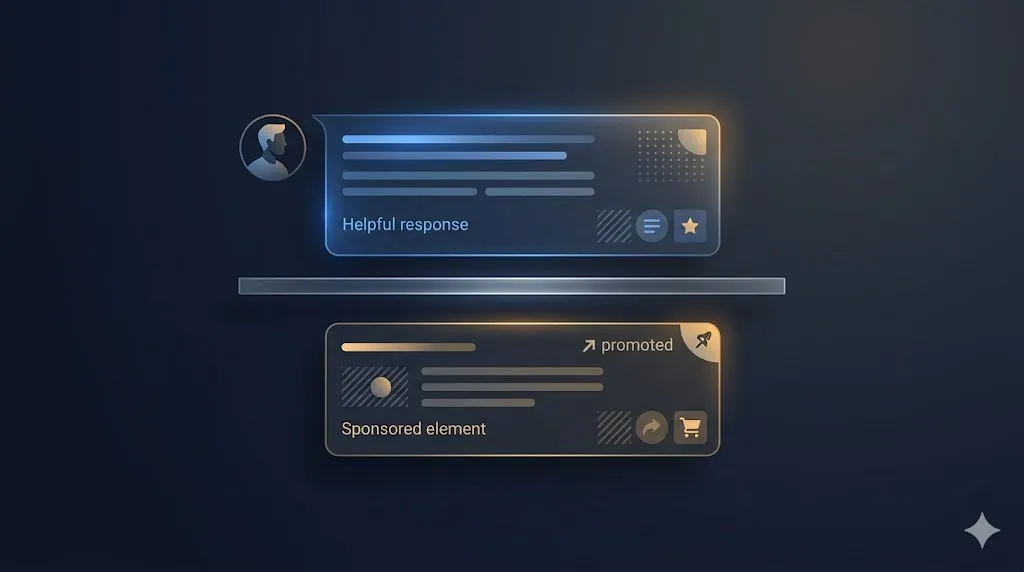
The most important part for regular users is this: OpenAI says ads are clearly labeled, shown separately from ChatGPT’s answers, and do not influence the answers the model gives. That does not mean nothing is changing, but it does mean the ad system is being introduced as an extra layer around the chat experience rather than as sponsored text inside the answer itself.
- OpenAI says ads may appear for Free and Go users, while Plus, Pro, Business, Enterprise, and Edu accounts remain ad-free.
- Ads currently appear below relevant responses, not inside the answer body.
- OpenAI says advertisers do not get access to your chats, chat history, memories, or personal details.
- Free users may also have an Ads-Free option in eligible regions, but OpenAI says that choice can reduce usage limits and feature access.
Table of Contents
- Who May See ChatGPT Ads Right Now
- Where Ads Appear and What They Look Like
- What Stays the Same
- What OpenAI Says About Privacy and Controls
- What the Ads-Free Option Changes
- What Free Users Are Most Likely to Care About
- What Free Users Should Expect Next
- FAQ
- Sources
Who May See ChatGPT Ads Right Now
OpenAI’s help center says the current rollout is limited. The company’s main FAQ says ads are currently only rolling out in the US, Australia, New Zealand, and Canada, and that the test may change as expansion continues.
OpenAI also says the audience is narrow by plan type. During the test, ads may appear for Free and Go users. OpenAI says Plus, Pro, Business, Enterprise, and Edu accounts will not have ads. The company also says it will not show ads in accounts where the user says, or OpenAI predicts, that the user is under 18.
If you are a Free user outside those countries, you may not see anything yet. If you are a paid user, the official guidance is simpler: your ChatGPT experience remains ad-free.
Where Ads Appear and What They Look Like
According to OpenAI, ads can appear below the end of a response. They are labeled as sponsored and visually separated from the chat output. OpenAI’s ad-format documentation says an ad can include the advertiser name, logo, headline, description, landing page, and image creative.
That layout matters because it answers the biggest fear many users had when “ChatGPT ads” first started circulating. The official design is not described as paid sentences inserted into the middle of a reply. It is described as a separate ad unit placed under relevant conversations.
OpenAI’s FAQ also says ads do not currently appear in several situations during the test, including Temporary Chats, after image generation, and in the ChatGPT Atlas browser. These details matter because they show the rollout is still tightly scoped rather than universal across every surface.
What Stays the Same
This is the section many users care about most. OpenAI says ads do not influence ChatGPT’s answers. The company states that ads run on separate systems from the chat model and that advertisers have no ability to shape, rank, or alter ChatGPT responses.
That means the current official position is clear on three points:
- Answers are still generated by the model, not by advertisers.
- Seeing an ad does not mean OpenAI endorses the product or service.
- Paid plans named in the FAQ remain ad-free.
There is another practical point that stays the same for many Free users: rate limits still exist. OpenAI’s Free Tier FAQ continues to describe usage caps for GPT-5.5 and separate limits for tools such as file uploads, data analysis, and image creation. Ads are being introduced alongside that free-plan structure, not as a replacement for it.
What OpenAI Says About Privacy and Controls
OpenAI says it does not share your conversations with advertisers and does not sell your data to advertisers. The help article says advertisers do not receive access to chats, chat history, memories, or personal details. Instead, OpenAI says advertisers receive only aggregated, non-identifying performance data such as total views or clicks.
That does not mean ads are context-blind. OpenAI says ad selection starts with what is being discussed in your current chat thread. If a user chooses personalized ads, OpenAI says it may also use additional signals, including past chats and ad interactions, to improve relevance over time.
Users in the eligible rollout can manage this through Settings > Ad Controls. OpenAI says users may be able to turn off ad personalization, clear ads data, see why an ad appeared, dismiss ads, and report ads that seem misleading or inappropriate. The company also points users to its official ad policies for the categories and contexts where ads are not allowed.
What the Ads-Free Option Changes
One detail that may surprise users is that OpenAI now describes an Ads-Free option on the ChatGPT Free plan in eligible regions. This is not the same as upgrading to Plus or Pro. Instead, OpenAI says a Free user can choose to remove ads by accepting lower usage limits and reduced feature access.
OpenAI’s help page gives examples of what may change on Ads-Free: fewer messages and no access to some tools such as image generation or deep research. So the tradeoff is straightforward. The ad-supported Free experience may offer broader access, while the Ads-Free Free option cuts ads but also cuts capability.
That is why the headline “ChatGPT now has ads” needs context. For many people, the real change is not just the presence of advertising. It is that OpenAI is now using ads as one of the levers for how much free access a user gets.
What Free Users Are Most Likely to Care About
When ads enter a product people use for answers, user reaction usually turns on trust more than design. The most comfortable users are the ones who believe the sponsored blocks are clearly labeled, visually separate from the answer, and easy to ignore. If that line stays clear, many free users will simply treat ads as the cost of keeping broader no-cost access available.
The negative reaction tends to come from two places. Some users worry that any ad layer could eventually pressure the product toward commercial influence, even if the company says ads do not affect answers. Others become more cautious the moment ad targeting enters the discussion, especially if they already worry about privacy. That does not automatically make the product unusable, but it does mean trust can drop quickly if controls or labeling feel vague.
So the practical question is not just whether ChatGPT has ads. It is whether OpenAI can keep a clean boundary between answer quality, monetization, and user data controls. Free users usually accept ad-supported products more easily when those boundaries are visible and predictable.
What Free Users Should Expect Next
If you use ChatGPT for casual questions, shopping comparisons, or everyday research, the most likely immediate change is simple: in eligible regions, you may start seeing a sponsored block under some responses when the conversation context matches an advertiser.
What you should not expect, based on current official documentation, is a flood of ads inside every answer or a sudden change to paid plans. OpenAI says the rollout is phased, region-limited, and separate from the response system itself.
As of May 8, 2026, the safest summary is this: Free and Go users in a few countries may start seeing clearly labeled ads below relevant chats, while paid users keep an ad-free experience. The biggest things staying the same are the answer engine, the separation between ads and responses, and OpenAI’s claim that advertisers do not get direct access to your chats.
Bottom Line
ChatGPT ads are now part of the product for some users, but the current rollout is narrower and more controlled than many people feared. The useful way to think about it is not “ChatGPT answers are now sponsored.” It is “OpenAI has started testing a sponsored layer around some Free and Go conversations, with controls and tradeoffs attached.”
If you are a Free user in an eligible country, the key things to check are whether ads have appeared in your account, whether ad personalization is on, and whether the Ads-Free tradeoff is worth it for how you use ChatGPT. If you are on a paid plan, OpenAI’s current documentation says your experience stays ad-free.
FAQ
Do ChatGPT ads change the answers I get?
No. OpenAI says ads do not influence ChatGPT’s answers and are served by separate systems.
Which plans are ad-free?
OpenAI says Plus, Pro, Business, Enterprise, and Edu accounts do not have ads.
Can Free users avoid ads?
In eligible regions, OpenAI says some Free users can choose an Ads-Free option, but that comes with lower usage limits and reduced access to some features.